logo for matrixlab-examples.com
[?] Subscribe To This Site

XML RSS
Add to Google
Add to My Yahoo!
Add to My MSN
Subscribe with Bloglines


Home
Matrixmania Blog
Contact
-> Sitemap <-
Matlab Books
Quick Matlab Guide
Matlab Tutorials
Matlab Examples
Matlab Flow Control
Boolean Algebra
Linear Algebra
Matlab 2D Plots
Matlab 3D Plots
Matlab GUI
Matlab Cookbook I
Matlab Cookbook II
Probability and Stats
Forums and Help
Relevant Links
Fun!
Your own Website?
Terms/Policies
leftimage for matrixlab-examples.com

Cramer's Rule


The method of solution of linear equations by determinants is called Cramer's Rule. This rule for linear equations in 3 unknowns is a method of solving by determinants the following equations for x, y, z

a1x + b1y + c1z = d1
a2x + b2y + c2z = d2
a3x + b3y + c3z = d3 
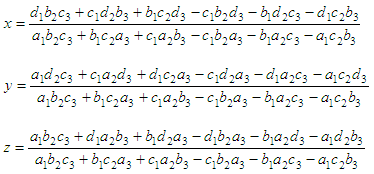
If we analytically solve the equations above, we obtain

x, y and z solved analytically

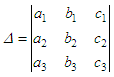
If determinant of coefficients for linear system  is the determinant of coefficients of x, y, z and is

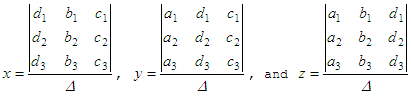
 assumed not equal to zero, then we may re-write the values as 

x, y and z solved by Cramer's Rule

The solution involving determinants is easy to remember if you keep in mind these simple ideas:

  • The denominators are given by the determinant in which the elements are the coefficients of x, y and z, arranged as in the original given equations.

  • The numerator in the solution for any variable is the same as the determinant of the coefficients with the exception that the column of coefficients of the unknown to be determined is replaced by the column of constants on the right side of the original equations. 

That is, for the first variable, you substitute the first column of the determinant with the constants on the right; for the second variable, you substitute the second column with the constants on the rigth, and so on...

Example:


Solve this system using Cramer’s Rule

2x + 4y – 2z = -6
6x + 2y + 2z = 8
2x – 2y + 4z = 12
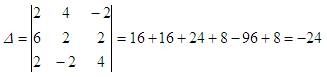
determinant of specific coefficients


For x, take the determinant above and replace the first column by the constants on the right of the system. Then, divide this by the determinant:
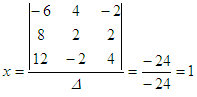
x solved by determinants

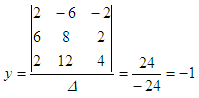
For y, replace the second column by the constants on the right of the system. Then, divide it by the determinant: 

y solved by determinant

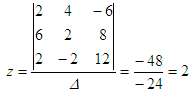
For z, replace the third column by the constants on the right of the system. Then, divide it by the determinant:

z solved by determinants (Cramer's Rule)

You just solved ths system!


In Matlab, it’s even easier. You can solve the system with just one instruction.

Let D be the matrix of just the coefficients of the variables:

D = [2  4 -2;
     6  2  2;
     2 -2  4];
 

Let b be the column vector of the constants on the rigth of the system :

b = [-6 8 12]'; % the apostrophe is used to transpose a vector

Find the column vector of the unknowns by 'left dividing' D by b (use the backslash), like this:

variables = D\b


And Matlab response is:

variables =
    1.0000
   -1.0000
    2.0000

Top

From 'Cramers Rule' to home
From 'Cramers Rule' to 'Linear Algebra'


footer for matlab page